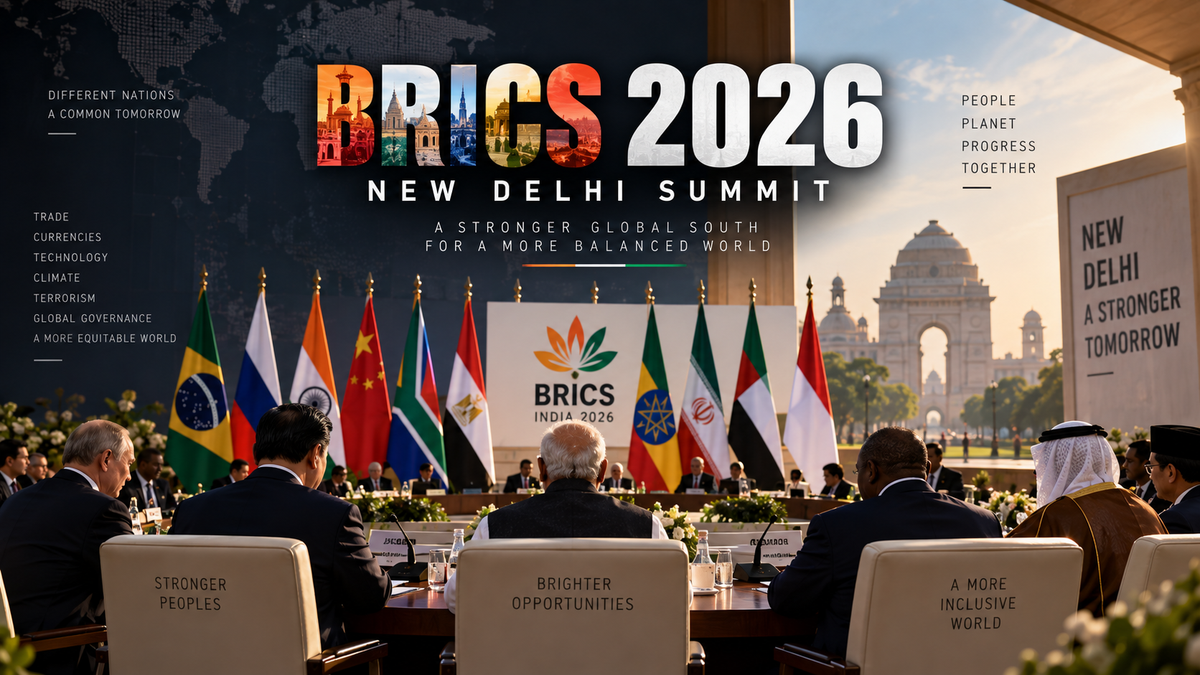
The BRICS Summit just happened in New Delhi.
But what exactly did the countries discuss?
The 18th BRICS Summit was held on 12 and 13 September 2026, with India as the chair. The theme was:
“Building for Resilience, Innovation, Cooperation and Sustainability.”
BRICS now brings together Brazil, Russia, India, China, South Africa, Egypt, Ethiopia, Iran, Indonesia, and the UAE, with Saudi Arabia also listed by the Indian government as part of the 11-member grouping. Saudi Arabia participated in the summit through its foreign minister.
So what was actually discussed?
1. Global trade and tariffs
BRICS criticised rising unilateral tariffs and trade restrictions, arguing that they can disrupt global trade and supply chains.
The declaration called for a more open and predictable global trading system centred around the WTO.
2. More use of local currencies
One of the recurring BRICS ideas is reducing friction in trade between member countries.
The summit supported making cross-border payments easier and increasing the use of national currencies.
But importantly, there was no new BRICS common currency announced.
3. Reforming the UN
BRICS again pushed for greater representation of developing countries in global institutions.
China and Russia reiterated support for India and Brazil having a greater role in the UN Security Council.
4. Terrorism
The New Delhi Declaration strongly condemned terrorism and specifically condemned the April 2025 Pahalgam terrorist attack in Jammu and Kashmir.
5. Middle East conflicts
The summit also discussed the ongoing conflict in West Asia.
The declaration called for restraint, diplomacy and protection of civilians and commercial shipping routes.
Interestingly, the final document avoided directly naming countries in some of the most divisive geopolitical issues.
6. AI and technology
AI was another important part of the discussion.
BRICS discussed AI governance, digital technologies, innovation and ways for developing countries to participate more meaningfully in the technology economy.
India also pushed initiatives around digital public infrastructure and industrial technology cooperation.
7. Climate, energy and development
Climate change, energy security, sustainable development, agriculture and resilient supply chains were also part of the declaration.
The broader goal was to increase cooperation between developing economies rather than treating BRICS only as a political grouping.
So What Was the Big Takeaway?
Maybe the most interesting thing about this BRICS summit wasn't one huge new agreement.
It was that 11 countries with very different interests managed to agree on a common 140-paragraph declaration.
There were disagreements over wars, trade, sanctions and geopolitics.
Yet they still found common ground around trade, development, technology, climate, financial cooperation and reform of global institutions.
And that's probably what BRICS is becoming.
Not a single unified political bloc.
But a platform where a large group of emerging economies can coordinate on issues where their interests overlap.
The world is becoming more multipolar.
And BRICS is one of the clearest places to watch that change happen.