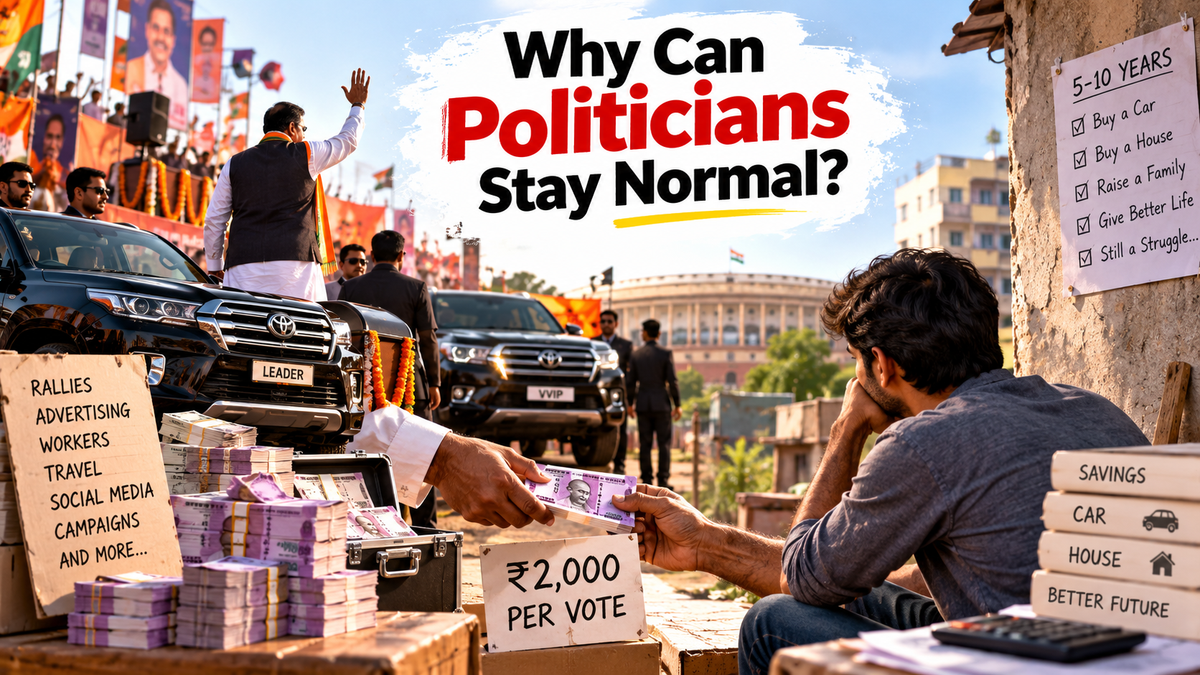
Think about the life of an ordinary person.
You work for years.
You earn a salary.
You save money.
You think about buying a car.
You think about buying a house.
And even after 5 or 10 years, those things can still feel difficult.
Then look at election politics.
Campaigns involve huge spending on advertising, workers, travel, rallies, social media and other activities. There are legal expenditure limits for candidates, but the Election Commission also monitors election spending and publishes expenditure statements. (Elections 24)
And then comes the strange part.
Some voters are willing to exchange their vote for a few thousand rupees.
But accepting money in exchange for voting for a candidate is treated as electoral bribery under Indian election law. (Election Commission of India)
We sometimes forget something very simple.
The person giving you money during an election isn't necessarily giving you free money.
Public money, government resources and political spending ultimately exist within a system that citizens fund and depend on.
And after taking that money, we can spend the next five years complaining about roads, hospitals, schools, jobs, corruption and basic services.
Then there is caste.
“He is from our caste. We'll vote for him.”
But why should someone's caste decide whether they can represent an entire constituency?
The Election Commission's Model Code of Conduct explicitly says parties and candidates should not appeal to caste or communal feelings to secure votes. (Election Commission of India)
Maybe we should ask different questions.
Can this person understand the problems of the constituency?
Do they have a record of working on them?
Do they understand education, healthcare, infrastructure, employment and public administration?
Can they actually explain what they want to change?
Instead, too often, the discussion becomes:
How much money are they giving?
Which caste are they from?
Which party are they from?
And then we wonder why the same problems keep coming back.
This isn't about saying every politician is corrupt or every election is driven by money.
It's about questioning the incentives we create as voters.
If we choose representatives based on money, identity or short term benefits, we shouldn't be surprised when politics starts revolving around those same things.
Maybe the real change doesn't begin with politicians.
Maybe it begins with what we demand from them.
Don't ask what they can give you for one vote.
Ask what they can build for the next five years.
Don't choose someone because they belong to your caste.
Choose based on what they have done, what they understand and what they propose to do.
Because a ₹2,000 note lasts for a day.
The consequences of a vote can last for five years.
And perhaps the real question isn't:
“Why are politicians so different from ordinary people?”
Maybe it is:
“When will we start treating our vote as something more valuable than a few thousand rupees?”