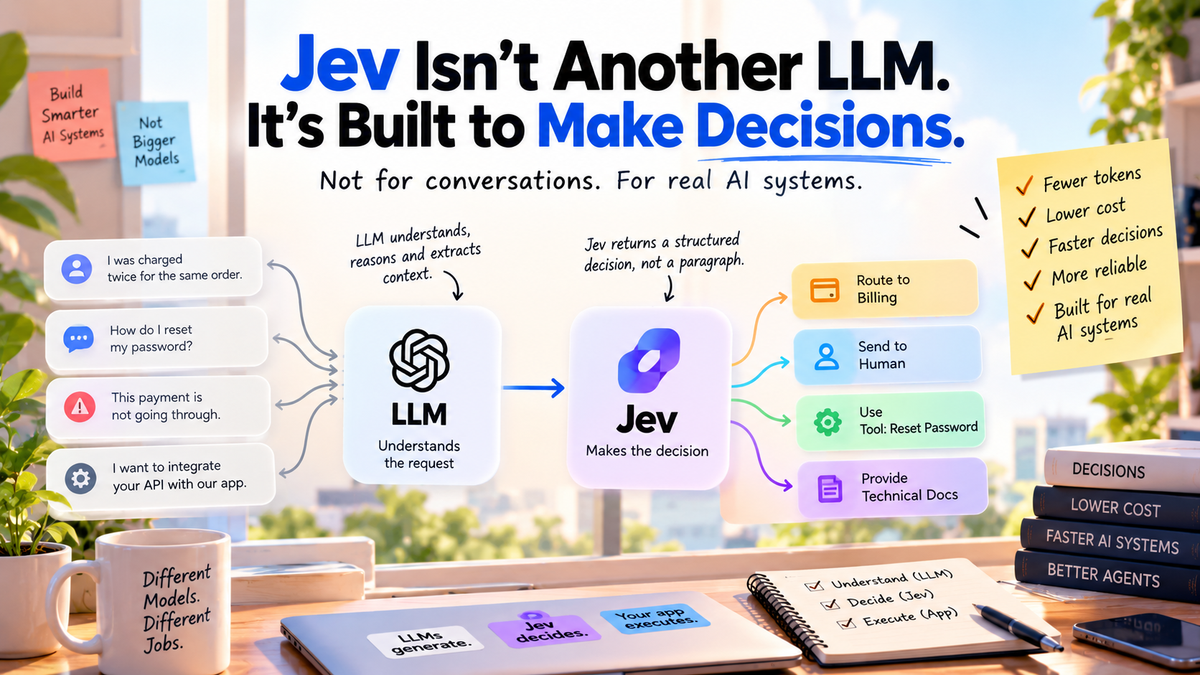
We keep building bigger AI models that can write, code, reason and chat.
But there's another problem inside AI systems.
Sometimes you don't need AI to generate an answer. You just need it to make a decision.
Which tool should an agent use?
Should this request go to a human?
Which option should the system choose?
How confident is the decision?
This is where Jev, created by TypeSafe AI, gets interesting.
Jev is designed as a decision model, not another general purpose LLM.
Imagine an AI support agent receives:
“I was charged twice for the same order.”
An LLM can understand the message and explain the problem.
But the software still needs to decide:
billing
technical
refund
human_review
Jev can handle that decision and return a structured result that the application can use directly.
So instead of:
User → LLM → Text → Parse → Decision
you can have:
User → LLM → Jev → Decision → Action
And this can also address one of the biggest problems with using large models everywhere.
Cost and token usage.
If every small decision requires sending a large prompt to an expensive LLM, those calls add up quickly.
More requests mean more tokens.
More tokens mean more cost and latency.
A specialized decision model can handle these smaller, repetitive decisions without asking a large generative model to do everything.
That can make an AI system more efficient, especially when the same type of decision happens thousands or millions of times.
The effectiveness comes from being focused on one job.
An LLM might return a detailed explanation when your application only needs:
refund
or
human_review
Jev is designed to return the decision itself in a structured way.
LLMs generate and reason. Jev is focused on deciding.
It isn't trying to replace ChatGPT or Claude.
It's solving a different problem.
Because sometimes you don't need another AI that can write more.
You need one that can simply answer: “What should happen next?”